





Omega-3: real benefits, sources and how to choose according to goals (EPA, DHA and ALA)
Do you want to understand omega-3 in a clear and science-based way?
In this article you will understand what omega-3 fatty acids (EPA, DHA and ALA) are, how they act in the body and what the evidence says in different key contexts: cardiovascular health, mental health, pregnancy and breastfeeding, male fertility and vegetarian or vegan diets.
We will conclude with dietary sources , plant-based alternatives such as algae oil, quality criteria when choosing a supplement, and practical conclusions so you know when to prioritize EPA, DHA, or ALA according to your goal and diet.
What is omega-3, how does it work, and what are its potential benefits?
Omega-3s are a type of "good" fat that our body needs but doesn't produce in sufficient quantities, so we must obtain them from our diet. The most important ones are:
-
EPA : helps control inflammation in the body. It is linked to heart health benefits and, in some studies, to support for mood problems such as anxiety or depression.
-
DHA : It is an essential building block in the brain and retina. It participates in communication between neurons and in vision, and plays a key role in pregnancy, breastfeeding, and male fertility.
-
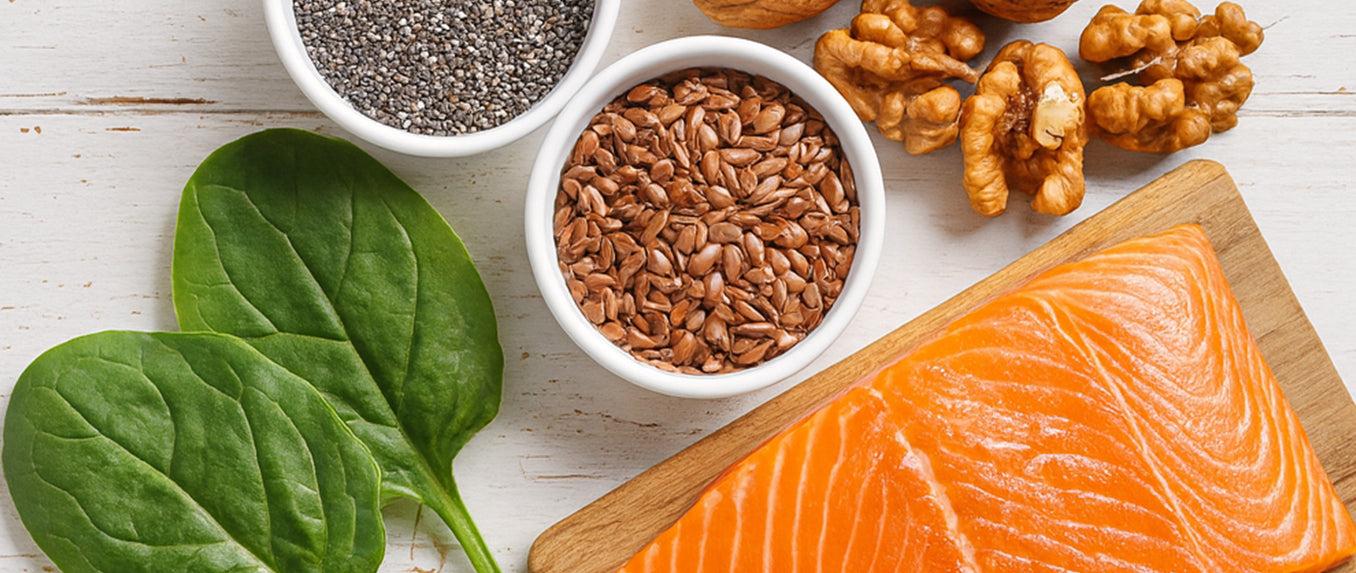
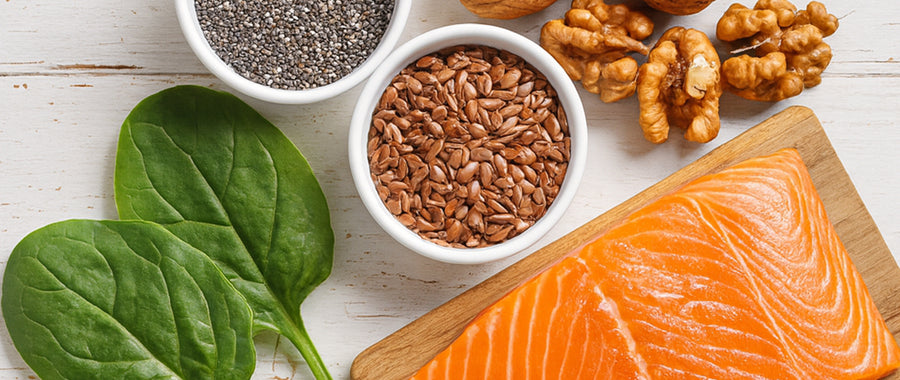
ALA : found in plant-based foods such as flax, chia seeds, and walnuts. Our bodies can convert it into EPA and a small amount into DHA, although this conversion is limited.

What does science say? What is it for?
Cardiovascular health
In people with elevated triglycerides taking cholesterol medication , a large study showed that a high dose of pure EPA (4 g/day) reduced the risk of heart attack and other serious heart problems (Bhatt et al., 2019). In general, evidence supports that EPA—and also the EPA+DHA combination —contributes to improving lipid profiles and reducing triglycerides , thus helping to maintain good cardiovascular health (Mozaffarian & Wu, 2011).
Mental health
Scientific reviews show that the effect of omega-3s on depression is modest but realistic : it can serve as complementary support , especially when the supplement contains more EPA than DHA.
Some authors suggest that its possible antidepressant action would be related to the modulation of inflammation and neuronal function , although clinical results remain moderate (Appleton et al., 2021; Su et al., 2018).
Pregnancy and breastfeeding
Increase EPA consumption And DHA during pregnancy can reduce the risk of premature birth , and for this reason it is recommended that pregnant and breastfeeding women adequately meet their DHA needs (Middleton et al., 2018; Best et al., 2022).
Male fertility
DHA is essential in sperm membranes. Men who consume more omega-3 have shown better semen quality in some studies, and reviews suggest improvements in sperm motility, although larger trials are lacking (Jensen et al., 2020; Hosseini et al., 2019).
Vegetarians and vegans
Plant-based omega-3 fatty acids , such as ALA , are found in foods like flax, chia seeds, and walnuts. The body can convert them into EPA and, to a lesser extent, DHA, but this process is not very efficient.
The reason is that the conversion requires several enzymes that also participate in other fat metabolic pathways, so only a small portion of the ALA is actually converted. In most people, that percentage is around 5%–10% for EPA and less than 1% for DHA (Burgeg & Wootton, 2002; Brenna et al., 2009).
This means that, although a diet rich in ALA contributes to cardiovascular health, it is not usually enough to cover the structural functions of DHA , which are essential for brain function, vision, and fertility.
In vegetarians and vegans, there may be a slight metabolic adaptation: their bodies convert slightly more ALA into EPA, but DHA levels remain low (Rosell et al., 2005). Sanders (2009) confirms this trend and emphasizes that algae oil is the most effective and direct way to meet DHA requirements without resorting to animal sources (Arterburn et al., 2008).

What should you look for when choosing a quality omega-3?
If you choose an omega-3 supplement, there are several aspects to consider:
-
Chemical form : Omega-3s can be present as natural triglycerides, ethyl esters, or carboxylates. All are valid and absorbable forms, but triglycerides generally show slightly greater bioavailability.
-
Actual EPA and DHA content : what matters is the exact amount of EPA and DHA per capsule, not the total milligrams of "fish oil" or "algae oil".
-
Purity and contaminants : a quality omega-3 should be free of heavy metals, dioxins and PCBs.
-
Oxidation : fatty acids are very sensitive; therefore, it is advisable that the product incorporates natural antioxidants and is stored under appropriate conditions.
-
Quality certifications : seals such as IFOS (International Fish Oil Standards) and IAOS (International Algal Oil Standards) and the GOED organization (Global Organization for EPA and DHA Omega-3s) guarantee purity and traceability.
Specific certifications in algae oils
In the case of plant-based omega-3, in addition to purity seals, certifications can be found that guarantee vegan status and sustainability:
-
V-Label : highly recognized in Europe, it guarantees that the product is 100% free of animal ingredients.
-
The Vegan Society Trademark : a British seal with an international presence that certifies vegan products in composition and processing.
-
Non-GMO Project Verified : guarantees the absence of genetically modified organisms, common in US algae oils.
-
USP or NSF : certifications from independent laboratories that validate potency, purity, and good manufacturing practices.

Conclusions
EPA , DHA , and ALA perform distinct and complementary functions . EPA is key in inflammation, cardiovascular risk, and anxiety-depressive symptoms; DHA is essential for brain function, vision, and male fertility; ALA contributes to cardiometabolic health, but does not, on its own, fulfill the functions of DHA.
In vegetarians and vegans , metabolic adaptation somewhat improves the conversion of ALA, but not enough , and algae oil is the best option to ensure adequate levels of DHA.
Finally, it is very important to know how to choose a quality omega-3 : it is advisable to look at the chemical form, the actual content of EPA and DHA, the purity, the protection against oxidation and the presence of reliable certifications that guarantee its safety and sustainability.
And as we always remind you: if you are not clear about your goals or do not have knowledge of nutrition, it is best to consult with a health professional who can guide you in your particular case.
References
-
Appleton KM, Voyias PD, Sallis HM, Dawson S, Ness AR, Churchill R, Perry R. Omega-3 fatty acids for depression in adults. Cochrane Database Syst Rev. 2021 Nov 24;11(11):CD004692. doi: 10.1002/14651858.CD004692.pub5. PMID: 34817851; PMCID: PMC8612309.
-
Arterburn LM, Oken HA, Bailey Hall E, Hamersley J, Kuratko CN, Hoffman JP. Algal-oil capsules and cooked salmon: nutritionally equivalent sources of docosahexaenoic acid. J Am Diet Assoc. 2008 Jul;108(7):1204-9. doi: 10.1016/j.jada.2008.04.020. PMID: 18589030.
-
Best KP, Gold M, Kennedy D, Martin J, Makrides M. Omega-3 long-chain PUFA intake during pregnancy and allergic disease outcomes in the offspring: a systematic review and meta-analysis of observational studies and randomized controlled trials. Am J Clin Nutr. 2016 Jan;103(1):128-43. doi: 10.3945/ajcn.115.111104. Epub 2015 Dec 16. PMID: 26675770.
-
Bhatt DL, Steg PG, Miller M, Brinton EA, Jacobson TA, Ketchum SB, Doyle RT Jr, Juliano RA, Jiao L, Granowitz C, Tardif JC, Ballantyne CM; REDUCE-IT Investigators. Cardiovascular Risk Reduction with Icosapent Ethyl for Hypertriglyceridemia. N Engl J Med. 2019 Jan 3;380(1):11-22. doi: 10.1056/NEJMoa1812792. Epub 2018 Nov 10. PMID: 30415628.
-
Brenna JT, Salem N Jr, Sinclair AJ, Cunnane SC; International Society for the Study of Fatty Acids and Lipids, ISSFAL. alpha-Linolenic acid supplementation and conversion to n-3 long-chain polyunsaturated fatty acids in humans. Prostaglandins Leukot Essent Fatty Acids. 2009 Feb-Mar;80(2-3):85-91. doi: 10.1016/j.plefa.2009.01.004. Epub 2009 Mar 9. PMID: 19269799.
-
Burdge GC, Wootton SA. Conversion of alpha-linolenic acid to eicosapentaenoic, docosapentaenoic and docosahexaenoic acids in young women. Br J Nutr. 2002 Oct;88(4):411-20. doi:10.1079/BJN2002689. PMID: 12323090.
-
Hosseini B, Nourmohamadi M, Hajipour S, Taghizadeh M, Asemi Z, Keshavarz SA, Jafarnejad S. The Effect of Omega-3 Fatty Acids, EPA, and/or DHA on Male Infertility: A Systematic Review and Meta-analysis. J Diet Suppl. 2019;16(2):245-256. doi: 10.1080/19390211.2018.1431753. Epub 2018 Feb 16. PMID: 29451828.
-
Innis SM. Dietary (n-3) fatty acids and brain development. J Nutr. 2007 Apr;137(4):855-9. doi: 10.1093/jn/137.4.855. PMID: 17374644.
-
Jensen TK, Priskorn L, Holmboe SA, Nassan FL, Andersson AM, Dalgård C, Petersen JH, Chavarro JE, Jørgensen N. Associations of Fish Oil Supplement Use With Testicular Function in Young Men. JAMA Network Open. 2020 Jan 3;3(1):e1919462. doi: 10.1001/jamanetworkopen.2019.19462. PMID: 31951274; PMCID: PMC6991322.
-
Middleton P, Gomersall JC, Gould JF, Shepherd E, Olsen SF, Makrides M. Omega-3 fatty acid addition during pregnancy. Cochrane Database Syst Rev 2018 Nov 15;11(11):CD003402. doi: 10.1002/14651858.CD003402.pub3. PMID: 30480773; PMCID: PMC6516961.
-
Mozaffarian D, Wu JH. Omega-3 fatty acids and cardiovascular disease: effects on risk factors, molecular pathways, and clinical events. J Am Coll Cardiol. 2011 Nov 8;58(20):2047-67. doi: 10.1016/j.jacc.2011.06.063. PMID: 22051327.
-
Rosell MS, Lloyd-Wright Z, Appleby PN, Sanders TA, Allen NE, Key TJ. Long-chain n-3 polyunsaturated fatty acids in plasma in British meat-eating, vegetarian, and vegan men. Am J Clin Nutr. 2005 Aug;82(2):327-34. doi: 10.1093/ajcn.82.2.327. PMID: 16087975.
-
Sanders TA. DHA status of vegetarians. Prostaglandins Leukot Essent Fatty Acids. 2009 Aug-Sep;81(2-3):137-41. doi: 10.1016/j.plefa.2009.05.013. Epub 2009 Jun 4. PMID: 19500961.
-
Su KP, Tseng PT, Lin PY, Okubo R, Chen TY, Chen YW, Matsuoka YJ. Association of Use of Omega-3 Polyunsaturated Fatty Acids With Changes in Severity of Anxiety Symptoms: A Systematic Review and Meta-analysis. JAMA Network Open. 2018 Sep 7;1(5):e182327. doi: 10.1001/jamanetworkopen.2018.2327. PMID: 30646157; PMCID: PMC6324500.
Read more
-

Desequilibrio hormonal: síntomas, causas y cómo recuperar el equilibrio hormonal
El desequilibrio hormonal puede afectar a la energía, el sueño, el estado de ánimo o el ciclo menstrual, tanto en mujeres como en hombres. Descubre cuáles son sus síntomas más frecuentes, qué factores pueden provocarlo y cómo mejorar la salud hormonal a través de la alimentación, el descanso y los hábitos de vida. -

How to sleep well: habits to improve your rest and your health
Sleeping well is one of the basic pillars of health, and the quality of our rest can be improved with simple and sustainable habits over time. Overnight, The body carries out reparative processes: the brain consolidates memories and clears toxins; the body regenerates tissues, synthesizes hormones such as growth hormone, and regulates the immune system. In metabolism, it balances signals such as leptin and ghrelin and modulates cortisol. -

Does creatine cause bloating or weight gain?
Learn why creatine doesn't cause bloating or weight gain and discover its multiple benefits -

Isabel Viña Bas: The Challenge of Supplements
Dr. Isabel Viña Bas talks about her passion for medicine, the complex development of her supplements, and how curiosity is key to understanding and optimizing our health. -
Adaptogens: your vitamins against stress.
How to be more resilient with the support of food supplements. -
Types of Magnesium: Benefits of Magnesium Bisglycinate and Malate
Find out what the different types of magnesium are and how they can help you. -

Basic Guide to Dietary Supplements and Vitamins
Discover the essential dietary supplements to start taking care of your health. Our basic guide to supplements will help you understand which vitamins and minerals are key for a healthy lifestyle. -

Benefits and properties of Magnesium
Discover the incredible benefits of magnesium for your health. Learn about the best magnesium supplements and how this essential mineral improves your muscles, takes care of your heart and ensures your rest -

Is it good to take vitamins? Find out if you need vitamin supplements
Learn how to determine if you need to take vitamin supplements to improve your health and quality of life. We'll help you answer your questions. -

Is it necessary to stop taking vitamin D in the summer? Myths and truths about this nutrient
In this article, we explain its myths and truths and why it is not necessary to stop your supplementation during the months of greatest sun exposure.


