






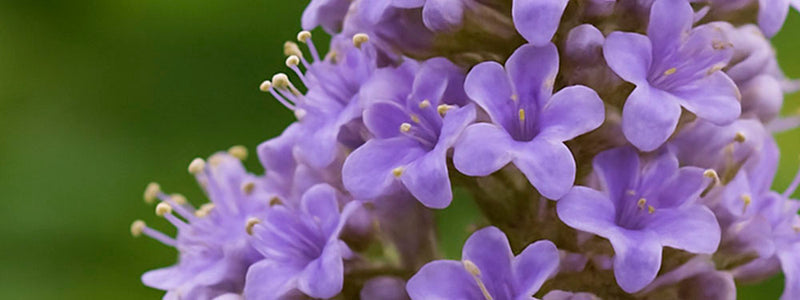
Vitex agnus-castus
Quick facts
 The standardized extract Ze 440 showed improvements in irritability, breast tenderness, and premenstrual discomfort in clinical trials, and has EMA recognition for PMS.

Vitex agnus-castus, commonly known as chasteberry, is a plant native to the Mediterranean region. Its fruits have been used for centuries in traditional medicine to alleviate discomfort related to the menstrual cycle.
Currently, standardized extracts from this plant—especially one called Ze 440—have been studied in clinical trials to assess their efficacy in premenstrual syndrome (PMS), cyclical mastalgia (breast pain associated with the cycle), and some cases of mild hyperprolactinemia.
How does it work?
- Gentle hormonal regulation: it may help balance prolactin levels, a hormone that, when slightly elevated, can shorten the luteal phase of the menstrual cycle and cause symptoms such as breast tenderness or cycle irregularities.
- Improvement of premenstrual symptoms: its action on dopamine receptors and cycle hormones is believed to reduce irritability, mood swings, and physical discomfort associated with PMS.
Benefits according to science
Premenstrual Syndrome (PMS)
Schellenberg and colleagues (2001) conducted a clinical trial on women with PMS over three menstrual cycles. Participants took 20 mg daily of Ze 440 extract or a placebo. The group taking Vitex experienced a clear improvement in symptoms such as irritability, mood swings, headaches, breast tenderness, and general malaise, with good tolerance.
In another study with 162 women (Schellenberg et al., 2012), various doses of Ze 440 (8, 20, and 30 mg/day) were compared against a placebo. The 20 mg/day dose achieved the best balance between efficacy and absence of adverse effects.
Cyclical mastalgia (cycle-associated breast pain)
Halaska and collaborators (1999) studied women with cyclical breast pain over three cycles. Taking a liquid preparation with Vitex significantly reduced pain compared to placebo, especially from the second cycle onwards.
Mild hyperprolactinemia
Milewicz and his team (1993) evaluated women with short luteal phases caused by slightly elevated prolactin. After three months with 20 mg of extract daily, prolactin levels were reduced, luteal phase duration normalized, and progesterone increased, with no significant adverse effects.
Dosage and forms of consumption
- Premenstrual syndrome: 20 mg/day of Ze 440 extract, once a day with meals, for at least three cycles.
- Cyclical mastalgia: liquid preparations or capsules equivalent in similar doses, for at least three cycles.
- Mild hyperprolactinemia: 20 mg/day of extract, always with medical evaluation and monitoring.
Note
The trials on premenstrual syndrome used the standardized Ze 440 extract, while the studies on cyclical mastalgia and mild hyperprolactinemia used other Vitex agnus-castus preparations. Therefore, the results obtained with Ze 440 cannot be directly extrapolated to all available market presentations.
Furthermore, the European Medicines Agency (EMA), through its Committee on Herbal Medicinal Products (HMPC), has evaluated the available evidence and recognizes the well-established use of the Ze 440 extract for premenstrual syndrome, recommending a daily dose of 20 mg as the most supported by clinical trials and safety data.
Safety and potential adverse effects
- Generally well-tolerated; in studies, adverse event rates were similar to placebo.
- Side effects, when they occur, are usually mild: digestive upset, headache, or infrequent skin reactions.
- Its use is not recommended during pregnancy or breastfeeding without medical supervision.
- If prolactin is very high due to a condition such as a pituitary adenoma, this treatment does not replace specific medication.
Conclusions
Vitex agnus-castus has several clinical trials supporting its efficacy in reducing premenstrual syndrome symptoms, alleviating cyclical breast pain, and improving hormonal parameters in cases of slightly elevated prolactin. The 20 mg/day dose of Ze 440 extract is the most studied and offers the best balance between efficacy and safety.
It does not replace medical treatment when indicated and should be part of a supervised plan that includes healthy habits and professional follow-up.
References
- Halaska M, Beles P, Gorkow C, Sieder C. Treatment of cyclical mastalgia with a solution containing a Vitex agnus castus extract: results of a placebo-controlled double-blind study. Breast. 1999 Aug;8(4):175-81. doi: 10.1054/brst.1999.0039. PMID: 14731436.
- https://www.ema.europa.eu/en/documents/herbal-report/final-assessment-report-vitex-agnus-castus-l-fructus-revision-1_en.pdf
- Milewicz A, Gejdel E, Sworen H, Sienkiewicz K, Jedrzejak J, Teucher T, Schmitz H. Vitex agnus castus-Extrakt zur Behandlung von Regeltempoanomalien infolge latenter Hyperprolaktinämie. Ergebnisse einer randomisierten Plazebo-kontrollierten Doppelblindstudie [Vitex agnus castus extract in the treatment of luteal phase defects due to latent hyperprolactinemia. Results of a randomized placebo-controlled double-blind study]. Arzneimittelforschung. 1993 Jul;43(7):752-6. German. PMID: 8369008.
- Schellenberg R, Zimmermann C, Drewe J, Hoexter G, Zahner C. Dose-dependent efficacy of the Vitex agnus castus extract Ze 440 in patients suffering from premenstrual syndrome. Phytomedicine. 2012 Nov 15;19(14):1325-31. doi: 10.1016/j.phymed.2012.08.006. Epub 2012 Sep 28. PMID: 23022391.
Schellenberg R. Treatment for the premenstrual syndrome with agnus castus fruit extract: prospective, randomised, placebo controlled study. BMJ. 2001 Jan 20;322(7279):134-7. doi: 10.1136/bmj.322.7279.134. PMID: 11159568; PMCID: PMC26589.