



Saffron
Quick facts
 Its compounds help reduce cellular oxidative damage, especially in neural tissues.

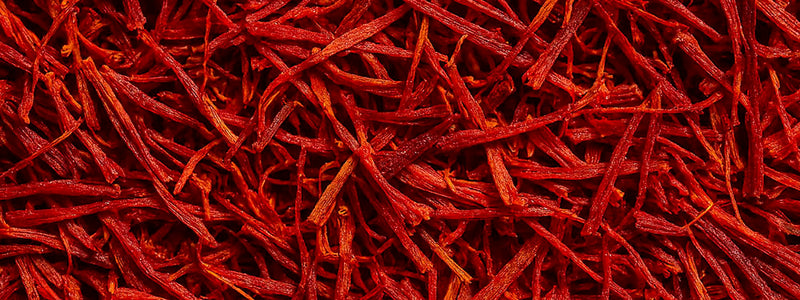
Saffron is a spice obtained from the dried stigmas of the Crocus sativus flower. In addition to its characteristic orange color and distinctive aroma, it is one of the most studied natural substances for its potential benefits on mood, anxiety, and certain cognitive parameters.
Although traditionally used in Persian medicine and Mediterranean cuisine, in recent years it has gained scientific attention for its content of bioactive compounds such as crocin, crocetin, picrocrocin, and safranal, responsible for its potential neuromodulatory and antioxidant effects.
How does it work?
- Mood Regulation: Several studies indicate that saffron may increase the availability of serotonin in the brain by inhibiting its reuptake, a mechanism similar to some antidepressants.
- Antioxidant and Anti-inflammatory Activity: Its compounds help reduce cellular oxidative damage, especially in neural tissues.
- Potential Anxiolytic and Neuroprotective Effect: It may modulate the hypothalamus-pituitary-adrenal axis, involved in the stress response.
Benefits According to Science
Improvement of Mood and Mild Depressive Symptoms
The most studied effect of saffron is its positive impact on mood in individuals with mild to moderate depressive symptoms.
In a randomized, double-blind trial with 40 adults with mild to moderate depression, Noorbala and his team (2005) administered 30 mg daily of saffron stigma extract for 6 weeks. The results showed similar improvements to the group treated with fluoxetine (20 mg/day), with no significant differences in adverse effects.
These results have been confirmed by other trials. For example, Lopresti and Drummond (2017) conducted a systematic review of human trials and concluded that saffron is significantly more effective than placebo for treating mild depressive symptoms, with similar efficacy to certain SSRIs (Antidepressants) but better tolerated.
Anxiety and Emotional Well-being
In addition to mood, saffron may help reduce anxiety.
In a placebo-controlled study involving 80 adolescents aged 12 to 16 with mild to moderate symptoms of anxiety or depression, Lopresti and colleagues in 2018 evaluated the effect of affron (standardized saffron extract, 14 mg twice daily) for 8 weeks. Participants showed significant improvements in emotional symptoms according to validated scales, with good tolerability.
Mild Cognitive Support
In individuals with mild cognitive impairment, saffron may have beneficial effects.
In a 22-week intervention trial conducted by Akhondzadeh and colleagues in 2010, 30 mg of saffron extract daily was administered to individuals with mild Alzheimer's disease. When compared with donepezil (a common medication in this context), both groups showed similar improvements in cognitive scales, but the saffron group presented fewer gastrointestinal adverse effects.
Dosage and Forms of Consumption
- Usual dosage in studies: between 28 and 30 mg daily of standardized saffron extract (e.g., Safrasol, affron, or Safr'Inside).
- Format: Standardized capsules with guaranteed crocin and safranal content.
- Minimum duration: 4 to 6 weeks to notice effects, although many studies extend up to 8 or 12 weeks.
- Recommended intake: 1 or 2 times a day, preferably with meals.
Safety and Potential Side Effects
- Saffron is well-tolerated at usual doses (up to 30 mg/day).
- In clinical trials, no serious side effects have been reported.
Some infrequent effects may include:
- Mild nausea or digestive discomfort.
- Mild headache.
- Mild drowsiness or nervousness, in isolated cases.
- Important: Although it is a natural substance, its use is not recommended for pregnant or breastfeeding women without medical supervision, as high doses could have a uterotonic effect.
Conclusions
Saffron is much more than an expensive spice. Clinical trials support its effectiveness as a natural aid for improving mood, relieving mild anxiety, and in certain cases, supporting cognitive function. Its effects are comparable to some antidepressant medications in mild cases, but with a lower risk of side effects.
While it should not replace medical treatment when necessary, it can be a useful complementary tool within a comprehensive approach that includes diet, physical activity, and emotional support. As always, professional supervision is key, especially in clinical cases.
References
- Akhondzadeh S, Shafiee Sabet M, Harirchian MH, Togha M, Cheraghmakani H, Razeghi S, Hejazi SS, Yousefi MH, Alimardani R, Jamshidi A, Rezazadeh SA, Yousefi A, Zare F, Moradi A, Vossoughi A. A 22-week, multicenter, randomized, double-blind controlled trial of Crocus sativus in the treatment of mild-to-moderate Alzheimer's disease. Psychopharmacology (Berl). 2010 Jan;207(4):637-43. doi: 10.1007/s00213-009-1706-1. Epub 2009 Oct 20. PMID: 19838862.
- Lopresti AL, Drummond PD, Inarejos-García AM, Prodanov M. affron®, a standardised extract from saffron (Crocus sativus L.) for the treatment of youth anxiety and depressive symptoms: A randomised, double-blind, placebo-controlled study. J Affect Disord. 2018 May;232:349-357. doi: 10.1016/j.jad.2018.02.070. Epub 2018 Feb 26. PMID: 29510352.
- Lopresti AL, Drummond PD. Saffron (Crocus sativus) for depression: a systematic review of clinical studies and examination of underlying antidepressant mechanisms of action. Hum Psychopharmacol. 2014 Nov;29(6):517-27. doi: 10.1002/hup.2434. Epub 2014 Sep 22. PMID: 25384672.
- Noorbala AA, Akhondzadeh S, Tahmacebi-Pour N, Jamshidi AH. Hydro-alcoholic extract of Crocus sativus L. versus fluoxetine in the treatment of mild to moderate depression: a double-blind, randomized pilot trial. J Ethnopharmacol. 2005 Feb 28;97(2):281-4. doi: 10.1016/j.jep.2004.11.004. Epub 2005 Jan 6. PMID: 15707766.