



Soy isoflavones
Quick facts
 Isoflavones bind to the body's estrogen receptors. This can help alleviate symptoms associated with estrogen decline during menopause.

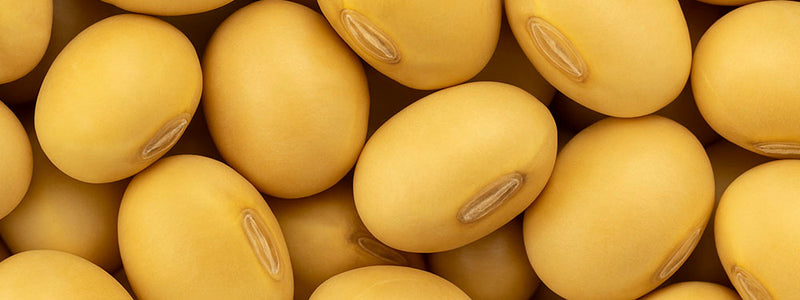
Soy is a legume native to Asia that has been consumed for centuries in the form of tofu, miso, tempeh, or plant-based milk. In addition to its protein content, it contains compounds called isoflavones, which belong to the group of phytoestrogens.
Its structural similarity to human estrogens has sparked scientific interest, particularly for its potential benefits during menopause, and for cardiovascular and bone health.
How do they work?
- Mild hormonal effect: Isoflavones bind to the body's estrogen receptors, albeit with much lower potency. This can help alleviate symptoms associated with estrogen decline during menopause.
- Bones and metabolism: They also participate in processes that regulate bone mineral density and blood lipid balance.
- Individual variability: Not all women respond the same way, as factors such as gut microbiota influence this (some individuals produce a metabolite called equol, which enhances the effects).
Benefits according to science
Hot flashes and night sweats
A 2013 Cochrane Library review led by Anne Lethaby analyzed clinical trials with postmenopausal women and concluded that isoflavones moderately reduce the frequency of hot flashes. However, in another review published in 2015, Chen MN. and his team confirmed this improvement, although results can vary among women, as not all metabolize soy in the same way.
Bone health
In a 2010 meta-analysis, Kyoko Taku and collaborators evaluated bone density in postmenopausal women who took isoflavone supplements. They observed a modest increase in the lumbar spine after several months of treatment, suggesting a potential protective role against osteoporosis.
Cholesterol and cardiovascular health
In 2006, Frank M. Sacks and a group of experts from the American Heart Association published a review on soy protein and isoflavones. They found modest reductions in LDL cholesterol (“bad cholesterol”).
That same research team had already shown in 2007 that the benefits were clearer in women with high cholesterol at the start of the treatment.
Breast cancer safety
Feng Chi and collaborators (2013) analyzed follow-up studies in women with breast cancer. They concluded that soy consumption does not increase the risk of recurrence; on the contrary, in Asian populations, it was even associated with increased survival.
Dosage and forms of consumption
- Hot flashes and menopause: Between 40 and 100 mg of isoflavones per day, in standardized extract capsules, for at least 12 weeks.
- Bones and cholesterol: Similar doses, typically for 3 to 12 months in clinical trials.
- Soy foods: Tofu, tempeh, soy milk, or miso also provide isoflavones, although in variable and lower amounts than supplements.
Note
Clinical trials on menopausal symptoms used standardized extracts of soy, with a defined isoflavone composition. Not all supplements on the market have the same quality or content, so research findings cannot be directly extrapolated to any product.
Safety and potential adverse effects
- Generally well-tolerated, with safety similar to placebo in trials.
- Side effects, when they occur, are usually mild: digestive discomfort or transient menstrual cycle irregularities.
- No negative effects on the thyroid have been observed in women with adequate iodine intake.
- Use during pregnancy or breastfeeding is not recommended without medical supervision.
Conclusions
Soy isoflavones have clinical trials that support their usefulness in alleviating hot flashes and night sweats during menopause, modestly improving bone density, and slightly reducing LDL cholesterol.
Their safety is good and side effects are infrequent. Although they do not replace hormone therapy when indicated, they can be a natural alternative for women seeking milder, well-tolerated support.
As always, consumption should be done with guidance and monitoring from a healthcare professional, especially for women with a history of hormone-dependent diseases or those taking medication.
References
- Chen MN, Lin CC, Liu CF. Efficacy of phytoestrogens for menopausal symptoms: a meta-analysis and systematic review. Climacteric. 2015 Apr;18(2):260-9. doi: 10.3109/13697137.2014.966241. Epub 2014 Dec 1. PMID: 25263312; PMCID: PMC4389700.
- Chi F, Wu R, Zeng YC, Xing R, Liu Y, Xu ZG. Post-diagnosis soy food intake and breast cancer survival: a meta-analysis of cohort studies. Asian Pac J Cancer Prev. 2013;14(4):2407-12. doi: 10.7314/apjcp.2013.14.4.2407. PMID: 23725149.
- Lethaby A, Marjoribanks J, Kronenberg F, Roberts H, Eden J, Brown J. Phytoestrogens for menopausal vasomotor symptoms. Cochrane Database Syst Rev. 2013 Dec 10;2013(12):CD001395. doi: 10.1002/14651858.CD001395.pub4. PMID: 24323914; PMCID: PMC10247921.
- Messina, M. (2016). Soy and Health Update: Evaluation of the Clinical and Epidemiologic Literature. Nutrients, 8(12), 754. https://doi.org/10.3390/nu8120754
- Sacks FM, Lichtenstein A, Van Horn L, Harris W, Kris-Etherton P, Winston M; American Heart Association Nutrition Committee. Soy protein, isoflavones, and cardiovascular health: an American Heart Association Science Advisory for professionals from the Nutrition Committee. Circulation. 2006 Feb 21;113(7):1034-44. doi: 10.1161/CIRCULATIONAHA.106.171052. Epub 2006 Jan 17. PMID: 16418439.
- Taku K, Melby MK, Kronenberg F, Kurzer MS, Messina M. Extracted or synthesized soybean isoflavones reduce menopausal hot flash frequency and severity: systematic review and meta-analysis of randomized controlled trials. Menopause. 2012 Jul;19(7):776-90. doi: 10.1097/gme.0b013e3182410159. PMID: 22433977.
- Taku K, Melby MK, Kurzer MS, Mizuno S, Watanabe S, Ishimi Y. Effects of soy isoflavone supplements on bone turnover markers in menopausal women: systematic review and meta-analysis of randomized controlled trials. Bone. 2010 Aug;47(2):413-23. doi: 10.1016/j.bone.2010.05.001. Epub 2010 May 7. PMID: 20452475.
- Taku K, Umegaki K, Sato Y, Taki Y, Endoh K, Watanabe S. Soy isoflavones lower serum total and LDL cholesterol in humans: a meta-analysis of 11 randomized controlled trials. Am J Clin Nutr. 2007 Apr;85(4):1148-56. doi: 10.1093/ajcn/85.4.1148. Erratum in: Am J Clin Nutr. 2007 Sep;86(3):809. PMID: 17413118.