


Iron: Why it's Key to Your Energy and Well-being (and How to Know If You're Lacking It)
El iron is a essential mineral for our body to function properly. Its main role is to contribute to the hemoglobin production, a protein present in the red blood cells and responsible for transporting oxygen from the lungs throughout the body. It participates in thousands of vital reactions; however, factors such as following a poor diet, menstruation, pregnancy, or engaging in intense exercise can significantly reduce its levels.
When we talk about iron the first thing that comes to mind is to think about the anemia, but the truth is that a deficiency can lead to many other symptoms that we often overlook, such as fatigue, difficulty concentrating, brittle hair, heavy periods, and cracked lips, among many others…
¿Por qué la deficiencia es tan común?
Many people live with chronic fatigue, hair loss, brain fog, or lack of energy without knowing that behind it there may be a iron deficiency...even if the tests don't show it. And the vast majority sometimes can't find a logical explanation for what is happening to them, because they have been told directly that there is nothing wrong with them.
However, throughout this article, we want to show you that the anemia is the final stage of a progressive decline in iron reserves, which can occur gradually over time. Often, what is not put into words seems not to exist, and failing to interpret certain symptoms can lead to delays in seeking medical help and adapting our lifestyle measures.
Thus, many times something as simple as optimizing our iron stores and the micronutrients involved in the hemoprotein synthesis
Phase 1: Iron depletion without anemia
- Iron stores in bone marrow, liver, and spleen starting to sell out.
- The ferritin starts to go down.
- Transferrin saturation (TSAT): still normal (>20%)
- Hemoglobin: still within normal ranges (>12 g/dl in women, 13 g/dl in men)
Phase 2: Iron deficiency without anemia
The iron available to form red blood cells is insufficient in this state. Production begins to fail, although there is no clinical anemia yet.
- Ferritin levels drop below 24 ug/L.
- IST: It falls below 20%, indicating that transferrin is transporting very little iron.
- Hemoglobin: may still be within the normal range (>12g/dL in women, 13 g/dl in men.
At this stage there is already a functional limitation. Our body has trucks(transferrin), but many of them circulate empty, no iron to transport, which is why the transferrin saturation is low.
It is a sign that iron is not properly reaching the tissues, even if anemia does not yet show up in the blood tests.
Phase 3: Iron deficiency anemia
Finally, hemoglobin levels fall below normal values and anemia begins.
- ferritin is very low.
- IST: (>20%-15%)
- Hemoglobin: already below 12g/dl in women and 13 g/dl in men.
However, you don't need to have anemia to suffer from those symptoms. A ferritin below desirable levels has a direct impact on our energy, mood, concentration, hair and nail health, or even our sleep quality if suffering from restless legs syndrome.
Even more so in women with heavy periods, or those going through menopause. Also if high-intensity sports (such as marathons) are practiced regularly.
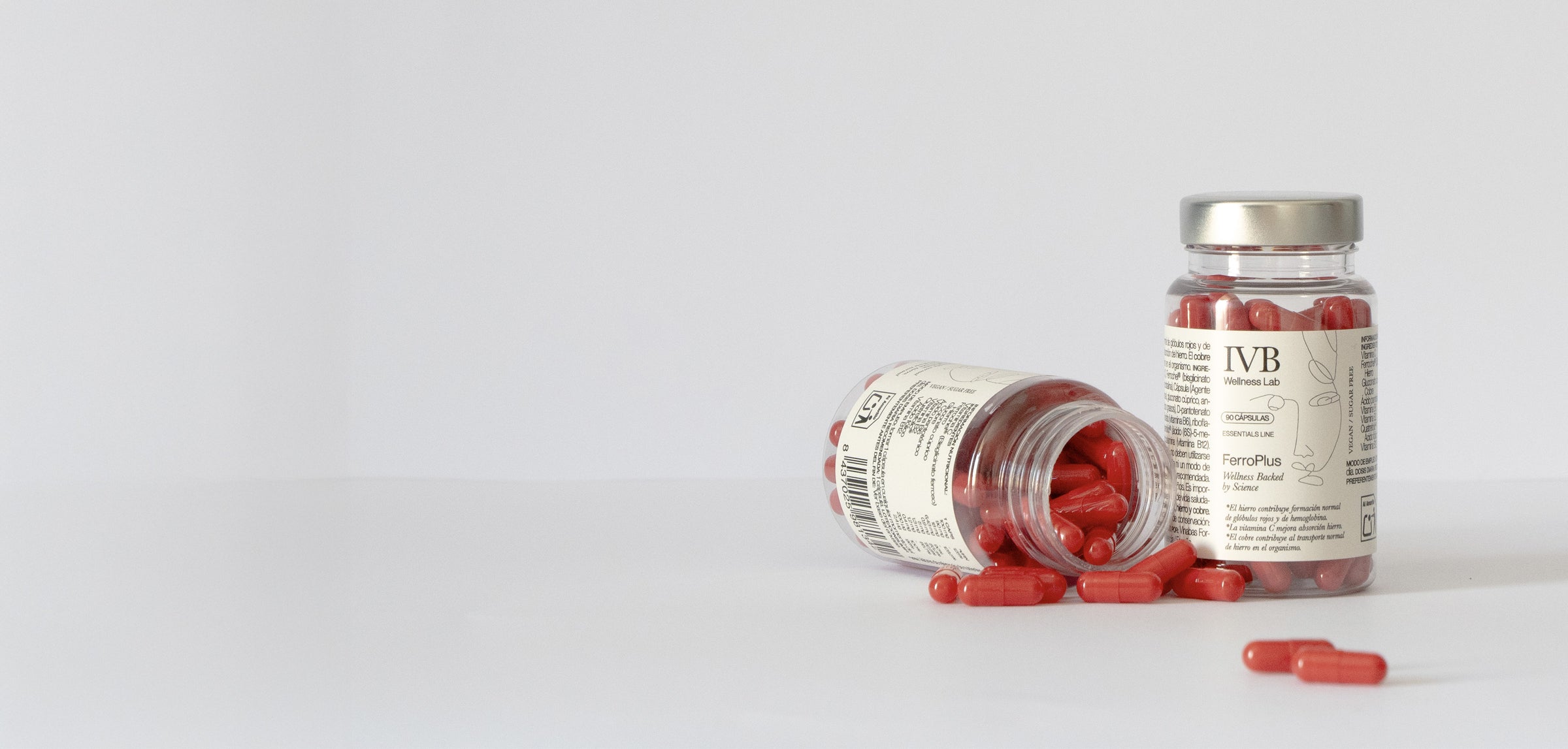
Therefore, along with a proper nutritional approach and medical assessment, FerroPlus is a iron dietary supplement that is very well tolerated by the digestive system, has high absorption, and is formulated to meet those specific needs.

What is FerroPlus and what are its benefits
It is a dietary supplement formulated with iron bisglycinate Ferrochel® which guarantees maximum absorption and tolerance gastrointestinal along with cofactors, such as vitamin C and copper for improve its bioavailability and B-complex vitamins enzymatically active ingredients that help with effective iron replenishment for the hemoprotein production.
- Prevents and treats iron-deficiency anemia
- Boosts energy and reduces fatigue
- Improve performance
- Boosts the immune system
Who it is for
- People with iron deficiency in blood tests (iron, ferritin or low transferrin saturation index), with or without accompanying anemia.
- People with symptoms consistent with iron deficiency (in the absence of other justifiable causes): such as fatigue, tiredness, difficulty concentrating, hair loss or more fragile and brittle hair, and cracked lips or sores, among others.
- Women with heavy periods, ...especially if they are associated with typical iron deficiency symptoms such as fatigue, hair loss, pale skin, or a slower mental response.
- People following a vegan diet
- Patients who have undergone bariatric surgery, such as gastric bypass
- People who engage in high-intensity endurance sports as gastrointestinal and sweat-related iron losses increase
- People recovering from blood loss due to injury or surgery.
How to get it?
Through nutrition, through aliron-rich foods such as red meat, chicken, fish... or ... legumes, spinach, tofu, or nuts. And when an extra boost is needed, through supplementation with supplements like FerroPlus.
Read more
-

The Impact of Cortisol (Stress) on Gut Inflammation and Immunity
Chronic stress and sustained elevated cortisol levels can alter the gut microbiota, intestinal barrier, and immune response, promoting a pro-inflammatory environment. In this article, we analyze what cortisol is, what symptoms it can cause when elevated, and what strategies can help protect gut health. -

Is it your thyroid or is it stress? How to differentiate persistent fatigue
Persistent fatigue can have multiple causes, ranging from thyroid disorders to chronic stress or nutritional deficiencies. Understanding how the thyroid works and what scientific evidence says is key to differentiating the origin of fatigue and addressing the problem appropriately. -

How to Combat Fatigue and Boost Energy
Discover the benefits of rhodiola extract to optimize your vitality, mood, and mental focus -

Adaptogens: your vitamins against stress.
How to be more resilient with the support of food supplements. -

Vitamin C and Collagen for Skin: How They Work Together
Vitamin C plays an essential role in the synthesis of collagen, a key protein for maintaining the skin's firmness, elasticity, and strength. In addition to participating in the formation of new collagen fibers, it helps protect the skin against oxidative stress associated with sun exposure, pollution, and aging. -

Zinc for acne: effects, forms, and recommended dosage
Zinc is an essential mineral for skin health that participates in processes related to cell renewal, inflammation, and sebum production. Scientific evidence suggests it may be useful as support in some cases of acne, especially when inflammatory lesions are predominant. -

Low Vitamin D: Causes, Symptoms, and What to Do
Low vitamin D can be caused by lack of effective sun exposure, a diet poor in vitamin D, obesity, intestinal absorption problems, or certain clinical contexts. Its symptoms are usually non-specific—fatigue, muscle pain, weakness, or reduced performance—which is why it's important to confirm it with a blood test and consider the full context. -

Magnesium for Sleep and Theanine: The Combination That Can Help You Rest Better
Discover how magnesium and L-theanine can help improve sleep quality, which forms of magnesium are most suitable, recommended dosages, and in which cases this combination can naturally promote relaxation and nighttime rest. -

Choline and pregnancy: a key nutrient for fetal neurodevelopment
During pregnancy, choline is an essential nutrient for fetal development that is often overlooked in favor of folic acid, iron, or iodine. Evidence suggests that many women do not meet the recommended intakes through diet alone, and that prenatal supplements often provide insufficient amounts. In this article, we review its role, what the science says, typical dosages, safety, and how to adjust intake at different stages of pregnancy. -

Omega-3: real benefits, sources and how to choose according to goals (EPA, DHA and ALA)
Understand omega-3 with a clear, evidence-based guide: what it is and how it works in our bodies. We review its role in cardiovascular and mental health, brain function, pregnancy, and male fertility. We include dietary sources and practical criteria for prioritizing EPA or DHA based on your goals, and we guide you in choosing a quality supplement: chemical form, purity, protection against oxidation, and certifications.


